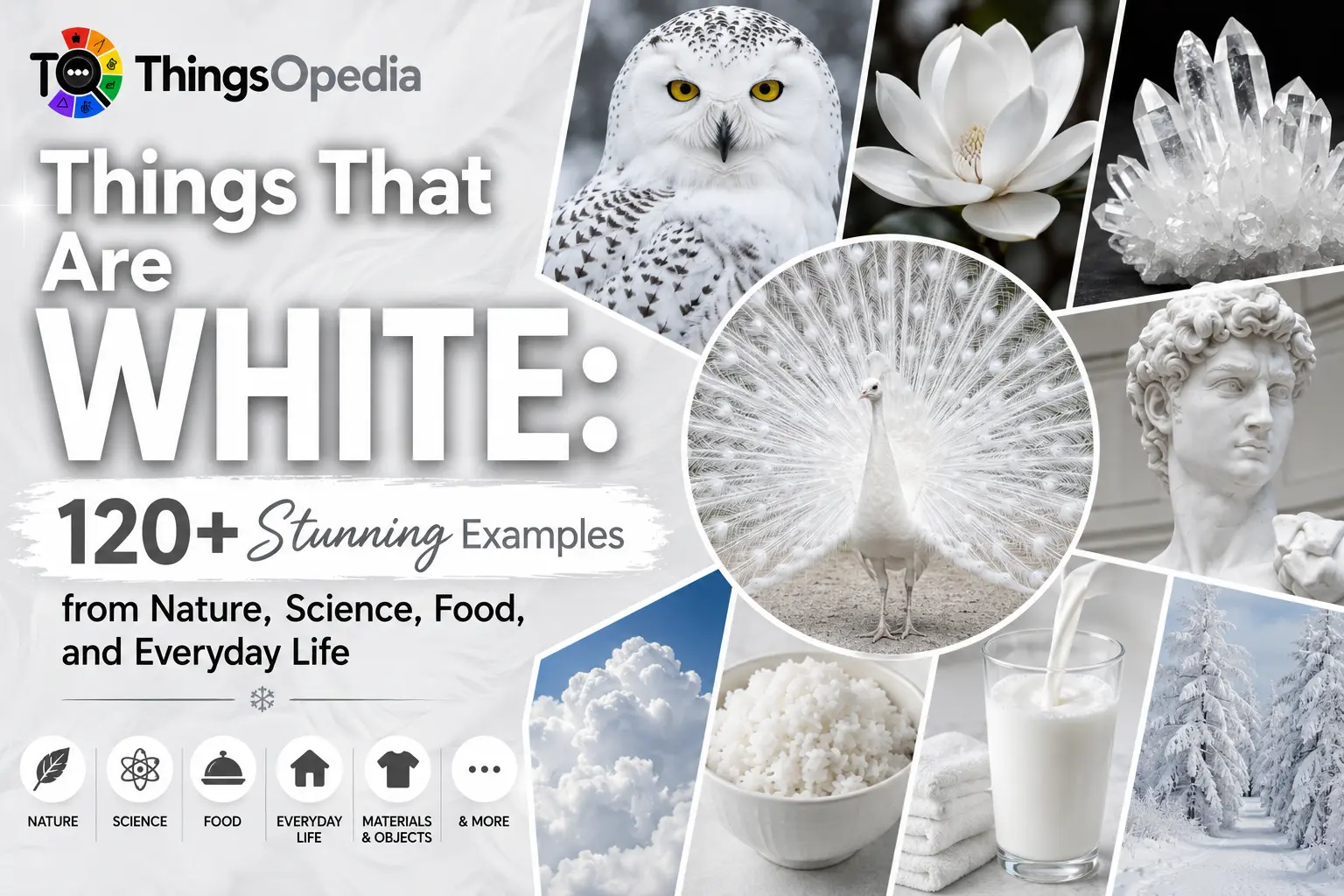
Things That Are White: 120+ Examples from Nature & Daily Life
White is one of the most recognizable and meaningful colors in the world. It represents purity, cleanliness, peace, simplicity, and freshness across many cultures. From snow-covered mountains and elegant flowers to everyday household items and incredible animals, white appears everywhere in nature and human life.
In this guide, you’ll discover more than 120 fascinating examples grouped into easy-to-browse categories. Whether you’re a student, writer, designer, teacher, or simply curious about the world, this collection offers practical information, fun facts, and real-world examples.
Let’s explore some of the most interesting white-colored objects found across nature, science, food, technology, and everyday living.
Why White Is So Common
White isn’t actually a pigment in many situations. Scientifically, white is produced when nearly all wavelengths of visible light are reflected equally. Many naturally white objects owe their appearance to microscopic structures that scatter light rather than to white-colored pigments.
Examples include:
- Fresh snow reflects around 80–90% of sunlight, making it appear brilliantly white.
- Polar bear fur appears white because its hollow hairs scatter light, although the skin underneath is black.
- Clouds look white because tiny water droplets scatter all colors of sunlight almost equally.
Things Found in Nature
Nature provides countless beautiful examples of white objects.
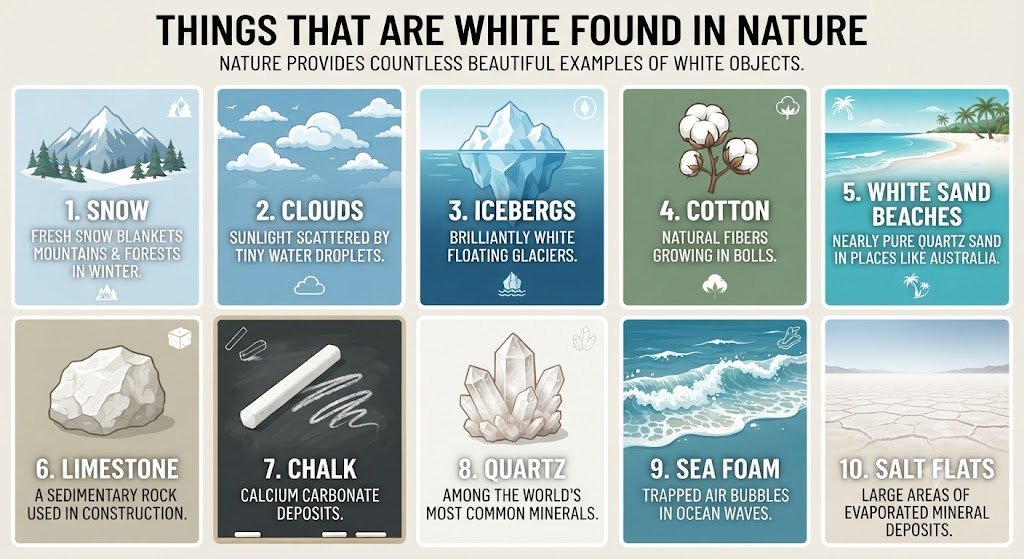
1. Snow
Fresh snow blankets mountains, forests, and fields every winter, creating some of Earth’s brightest landscapes.
2. Clouds
Many clouds appear white during the day because sunlight is scattered by tiny water droplets.
3. Icebergs
Large floating glaciers often look brilliantly white mixed with shades of blue.
4. Cotton
Cotton fibers naturally grow in fluffy white bolls before being processed into fabric.
5. White Sand Beaches
Certain beaches, such as those in Australia and the Maldives, contain nearly pure quartz sand.
6. Limestone
This sedimentary rock is widely used in construction and cement manufacturing.
7. Chalk
Natural chalk consists mainly of calcium carbonate.
8. Quartz
Milky quartz is among the world’s most common minerals.
9. Sea Foam
Ocean waves often produce bright white foam due to trapped air bubbles.
10. Salt Flats
Vast salt plains create spectacular white landscapes visible from space.
White Animals
Many animals use white coloration for camouflage or seasonal adaptation.
11. Polar Bear
Perfectly adapted to Arctic environments.
12. Arctic Fox
Its winter coat becomes completely white for camouflage.
13. Snowy Owl
One of the Arctic’s most recognizable birds.
14. Beluga Whale
Often called the “white whale.”
15. Ermine (Winter Stoat)
Changes from brown to white during winter.
16. White Rabbit
Popular as both pets and storybook characters.
17. White Dove
A universal symbol of peace.
18. Swan
Known for graceful movements and brilliant white feathers.
19. White Peacock
A rare genetic variation admired worldwide.
20. White Tiger
An uncommon Bengal tiger color mutation found mainly in captivity.
White Flowers
White flowers symbolize purity, sympathy, elegance, and new beginnings.
- Lily
- Daisy
- Jasmine
- Magnolia
- Gardenia
- White Rose
- Camellia
- Hydrangea
- Orchid
- Tulip
- Chrysanthemum
- Petunia
- Dogwood Blossom
- Baby’s Breath
- White Hibiscus
These flowers are popular choices for weddings and formal celebrations.
White Fruits and Vegetables
Many nutritious foods naturally have white flesh or skin.
Fruits
- Coconut
- Lychee
- White Peach
- White Grapes
- Pear (inside)
Vegetables
- Cauliflower
- Onion
- Garlic
- Potato (inside)
- Mushroom
- White Eggplant
- Turnip
- Parsnip
- Daikon Radish
- White Corn
- White Asparagus
- Kohlrabi
These foods contain fiber, vitamins, antioxidants, and minerals that support a balanced diet.
White Foods
Many kitchen staples are naturally white or become white after processing.
- Rice
- Milk
- Yogurt
- Butter
- Mozzarella Cheese
- Cottage Cheese
- Tofu
- Sugar
- Salt
- Flour
- Marshmallows
- Coconut Flakes
- Vanilla Ice Cream
- Whipped Cream
- Mayonnaise
- White Chocolate
- Popcorn
- Coconut Milk
- Cream Cheese
- Egg Whites
Many of these ingredients are essential in cuisines around the world.
Household Items
Almost every home contains numerous white objects.

- Paper
- Printer Paper
- Toilet Paper
- Tissue Box
- Ceramic Plate
- Mug
- Sink
- Bathtub
- Refrigerator
- Washing Machine
- Pillow
- Bedsheet
- Towel
- Light Switch
- Ceiling
- Wall Paint
- Door Frame
- Candle
- LED Light Bulb
- Soap
White remains one of the most popular colors in home interiors because it creates a clean and spacious appearance.
White Clothing and Fashion
Fashion frequently uses white to create timeless, elegant styles.
Examples include:
- Wedding Dress
- White Shirt
- Sneakers
- Lab Coat
- Chef Uniform
- Nurse Uniform
- Socks
- Baseball Uniform
- Tennis Outfit
- Silk Scarf
White clothing is especially common during summer because it reflects more sunlight than darker colors.
Technology and Office Items
Modern technology also features many white-colored products.
- Computer Mouse
- Keyboard
- Earbuds
- Charging Cable
- Printer
- Router
- Gaming Console
- Power Adapter
- USB Charger
- Smart Speaker
Minimalist product designs often use white because it appears modern and clean.
Science and Chemistry Examples
Several important scientific substances are naturally white.
- Calcium Carbonate
- Sodium Chloride
- Baking Soda
- Titanium Dioxide
- Kaolin Clay
- Talcum Powder
- Gypsum
- Marble
- Plaster
- Bone Ash
These materials are used in construction, medicine, cosmetics, paper manufacturing, and industrial production.
White in Transportation
Many vehicles and transportation-related objects are white.
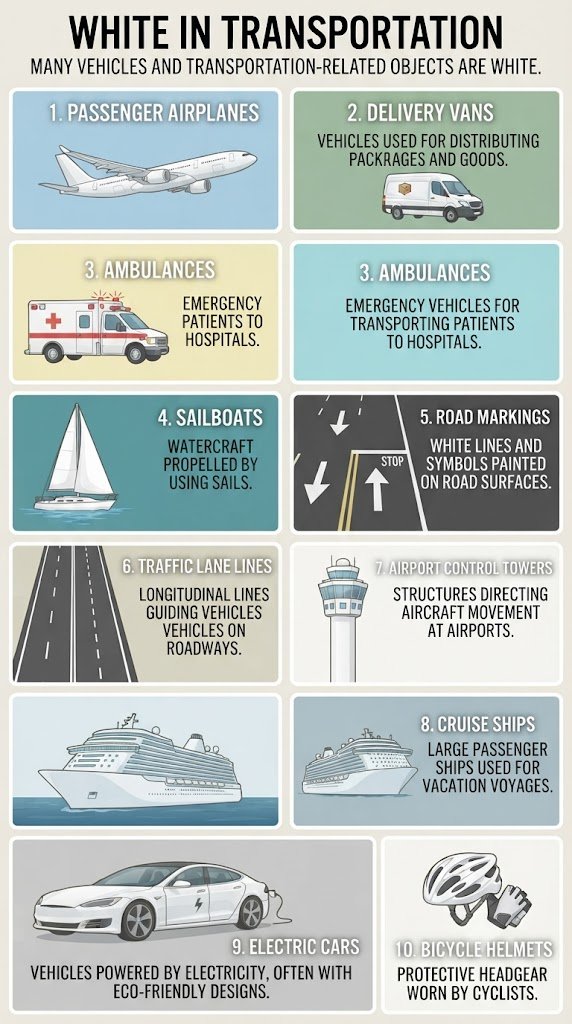
- Passenger Airplanes
- Delivery Vans
- Ambulances
- Sailboats
- Road Markings
- Traffic Lane Lines
- Airport Control Towers
- Cruise Ships
- Electric Cars
- Bicycle Helmets
Airlines often paint aircraft white because it reflects sunlight, helps regulate cabin temperature, and makes cracks or leaks easier to detect during maintenance.
White Objects in Space
Even beyond Earth, white appears frequently.
- The Moon (appears white from Earth)
- Saturn’s icy rings
- Comets
- Bright stars
- Ice-covered moons
- Space suits
- Rocket vapor clouds
Astronaut spacesuits are primarily white because they reflect heat and help maintain safe temperatures during spacewalks.
Cultural Meaning of White
White carries different meanings across cultures.
Common positive meanings
- Purity
- Peace
- Innocence
- Simplicity
- Honesty
- Freshness
- Hope
- Cleanliness
Cultural differences
In many Western countries, white symbolizes weddings and new beginnings. In several East Asian cultures, however, white is traditionally associated with mourning and remembrance. These differing meanings highlight how color symbolism depends on historical and cultural context.
Quick List: More White Examples
Here are even more white-colored objects:
- Pearl
- Eggshell
- Ivory Soap
- White Candle
- Domino Tile
- Ping Pong Ball
- Golf Ball
- Marble Statue
- Fence
- Picket Gate
- Whiteboard
- Envelope
- Envelope Seal
- Cotton Ball
- Medical Mask
- Bandage
- Chess Piece
- Snow Globe
- Popcorn Kernel
- Seashell
- Coral Sand
- Feather
- Vanilla Frosting
- Rice Paper
- Tortilla
- Noodle Dough
- Coconut Flesh
- White Bean
- Macadamia Nut
- Cashew
- Almond Milk
- Yogurt Cup
- Foam Cup
- Paper Napkin
- Chalkboard Eraser
- Ceramic Vase
- Table Lamp Shade
- Pillowcase
- Quilt
- Curtain
Fun Facts About White
- Polar bear fur is transparent, not truly white.
- The White Cliffs of Dover are composed mostly of chalk.
- Fresh snow can reflect up to 90% of sunlight.
- White LEDs actually produce blue light combined with phosphor coatings.
- Albino animals appear white because they lack melanin pigment.
- White paint is commonly used on roofs in warm climates to reduce heat absorption.
- Milk looks white because proteins and fat droplets scatter light.
- Most commercial paper is brightened using optical brightening agents.
- White marble has been prized by sculptors for thousands of years.
- Salt appears white because its tiny crystals reflect light efficiently.
Frequently Asked Questions
What are some common white objects?
Common examples include paper, milk, snow, clouds, rice, cotton, chalk, salt, eggs, lilies, towels, refrigerators, and ceramic dishes.
Why do many natural objects appear white?
Most naturally white objects reflect or scatter nearly all visible wavelengths of light equally. Their microscopic structures create the white appearance rather than white pigments alone.
Which animal is famous for being white?
The polar bear, snowy owl, beluga whale, and Arctic fox are among the world’s best-known white animals.
Is white considered a color?
In physics, white is the combination of all visible wavelengths of light. In pigments and printing, it often represents the absence of added color because the white surface reflects light.
Why is white popular in design?
White creates a clean, spacious, and modern appearance. It also pairs easily with nearly every other color, making it one of the most versatile choices in architecture, fashion, and product design.
You Might Also Like:
- 99+ Things That Are Gray: Nature, Animals, Materials & More
- 100+ Things That Are Black: Meanings & Everyday Uses
Final Thoughts
White is far more than a simple color. It appears in every aspect of our lives—from snowy landscapes and elegant flowers to nutritious foods, remarkable animals, household essentials, scientific materials, and modern technology. Its association with cleanliness, simplicity, and light has made it one of the most universally appreciated colors across cultures.
Whether you’re researching colors, preparing educational content, creating classroom materials, or simply expanding your knowledge, these examples demonstrate how remarkably diverse the world of white truly is.