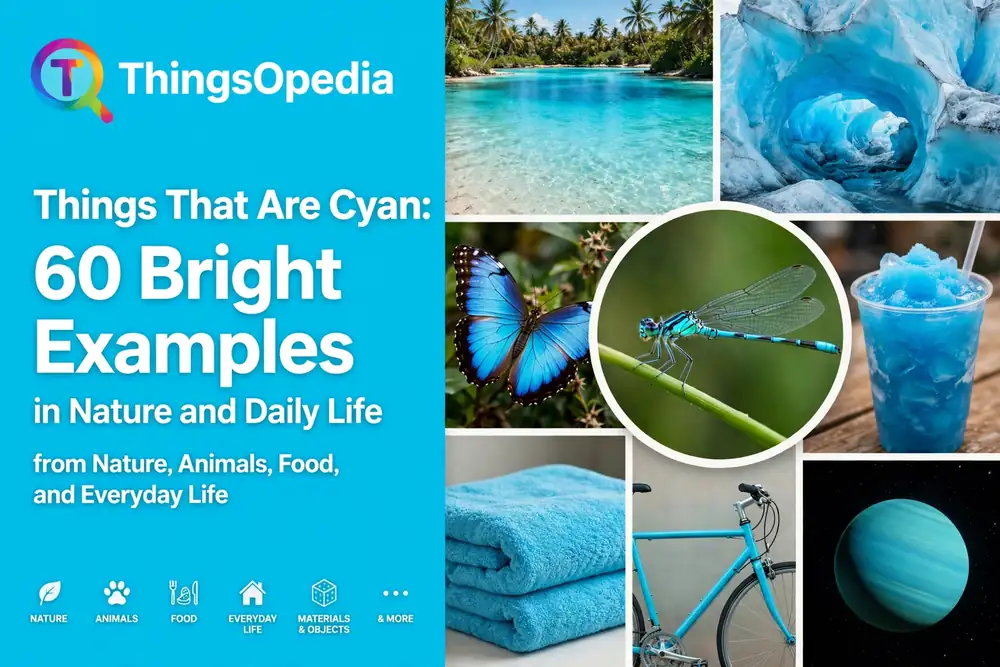
Things That Are Cyan: Bright Examples in Nature and Daily Life
Cyan is a bright blue-green colour that feels fresh and clean. You see it in clear sea water, in a summer sky, and in the glow of a swimming pool. It sits between blue and green, so it can look cool like water and lively like spring leaves at the same time.
Light makes cyan in a simple way. When blue light and green light reach your eyes together, you see cyan. In water and in the sky, red light is taken away, so the blue-green light that is left behind stands out. In this guide, you’ll discover 60 things that are cyan, from sea water and bright birds to food, clothes, and city buses, all explained in simple words.
Why Cyan Looks So Bright
Water looks cyan because it takes in red light and lets blue-green light pass through. Shallow water over white sand looks even brighter, because the light bounces off the sand and back through the water.
The sky can look cyan on a clear day because tiny air molecules scatter short light waves more than long ones. Near the middle of the sky, the scattered light looks blue-green to your eyes. In nature, copper minerals and some algae make cyan-green colours. In print and on screens, cyan is made by mixing blue light with green light, or by using cyan ink with magenta and yellow inks.
Cyan in Nature
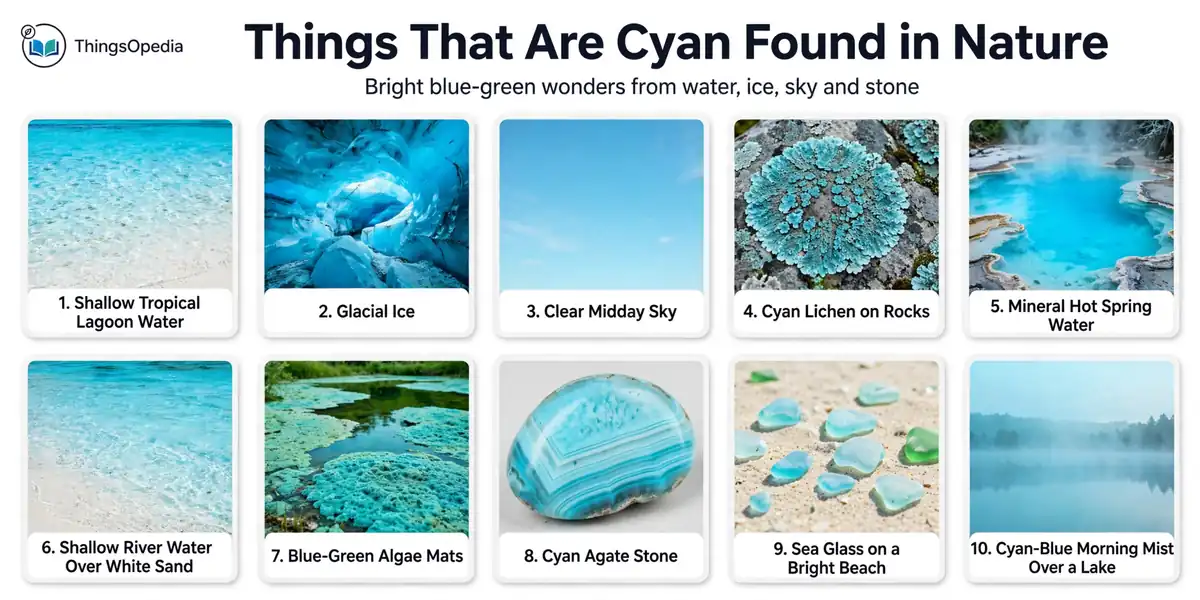
Clear water, bright skies, and pale rocks are among the things that are cyan in the open air.
1. Shallow Tropical Lagoon Water
Warm, shallow water around coral islands also looks bright cyan at midday. The water takes in red light, so only blue-green light reaches your eyes, and white sand below makes it look even brighter.
2. Glacial Ice
Deep in a glacier, old ice can also look vivid cyan in cracks and caves. Dense ice takes in red light and scatters blue-green light, so the deeper the ice, the stronger the colour.
3. Clear Midday Sky
On a dry, clear day, the sky overhead can also look pale cyan. Tiny air molecules scatter short light waves more than long ones, so blue-green light stands out near the middle of the sky.
4. Cyan Lichen on Rocks
Some lichen also grows in flat blue-green patches on bare rocks in clean mountain air. The lichen makes pigments that protect it from strong sun, and the patches can spread across whole stones.
5. Mineral Hot Spring Water
Some hot springs hold minerals that change how the water takes in light. In bright sun, the warm water can look a clear, glowing cyan.
6. Shallow River Water Over White Sand
Clear streams running over pale sand often look pale cyan. Sunlight passes through the shallow water, bounces off the sand, and mixes blue-green light on its way back up.
7. Blue-Green Algae Mats
In shallow ponds and warm lakes, blue-green algae grow in thick mats along the edge. Their pigments catch sunlight for food-making, and a thick mat can turn the water’s edge cyan-green.
8. Cyan Agate Stone
Some agate from volcanic rock shows pale cyan bands. Tiny quartz crystals and trace minerals make the bands, and collectors cut the stone to show them off.
9. Sea Glass on a Bright Beach
Old glass smoothed by waves can turn pale cyan where copper traces colour it. Each piece is shaped over many years by sand and water.
10. Cyan-Blue Morning Mist Over a Lake
On some cool mornings, mist over still water can look pale cyan-blue. Fine water drops scatter the low light, and the tint fades as the sun rises.
Cyan Animals
Few animals are fully cyan, but many show bright cyan feathers, scales, or wings.
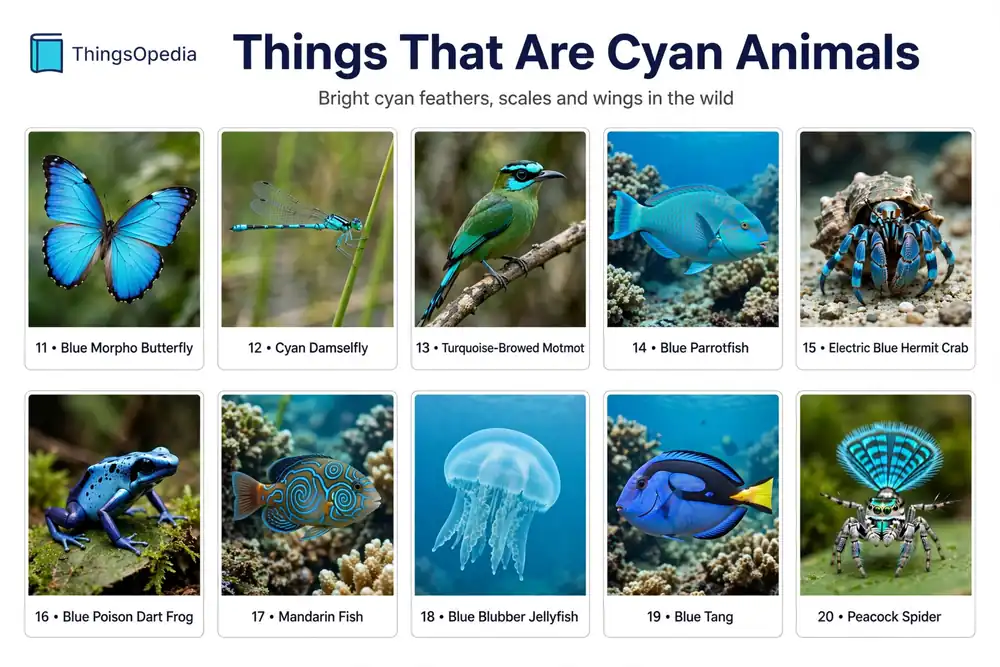
11. Blue Morpho Butterfly
The blue morpho also lives in Central and South American rainforests. Its wings flash cyan-blue because tiny scales bend light, not because of blue pigment, and the flash helps it confuse predators.
12. Cyan Damselfly
Some damselflies also live near clean ponds and slow streams, and the males show a bright cyan body. The colour helps them attract mates and mark a small patch of water as their own.
13. Turquoise-Browed Motmot
This bird lives in Central American forests and shows a bright blue-green patch on its long tail. It waves its tail slowly to warn other birds that it has seen danger.
14. Blue Parrotfish
The blue parrotfish lives on coral reefs, and males can show bright cyan-blue scales. It bites coral and grinds it, and the ground coral leaves the reef as fine sand.
15. Electric Blue Hermit Crab
This small crab lives in shallow tropical seas and shows bright cyan-blue bands on its legs. The bold colour helps it blend with reef light and warns other animals to keep away.
16. Blue Poison Dart Frog
This frog lives in rainforests in southern Suriname and shows bright blue skin that can look cyan in sunlight. The colour warns predators that its skin holds poison.
17. Mandarin Fish
The mandarin fish lives on Pacific coral reefs and shows swirling blue, green, and orange, with cyan-blue patches. It hides in coral during the day and feeds at dusk.
18. Blue Blubber Jellyfish
This jellyfish drifts in Australian coastal waters, and its bell can look pale cyan-blue in sunlight. It moves with the currents and eats small sea animals.
19. Blue Tang
The blue tang lives on coral reefs and shows a bright blue body with a yellow tail. In reef light, its body can look cyan-blue, and it hides in coral cracks at night.
20. Peacock Spider
This tiny spider lives in Australia, and the male raises a bright blue-green fan to attract a female. The fan flashes cyan in sunlight because of tiny scales on its back.
Cyan Flowers
Garden flowers in cyan are rare, so the few that exist stand out.
- 21. Blue Vanda Orchid — also grows in warm Asian gardens; some varieties open pale cyan-blue flowers that last for weeks.
- 22. Blue Delphinium — also grows in cool summer gardens; tall spikes carry pale cyan-blue flowers that attract bees.
- 23. Cyan-Blue Pansy — also grows in spring beds; some varieties show a clear cyan-blue face with a dark centre.
- 24. Blue Flax Flower — also grows in open fields; small flowers open cyan-blue in the morning and close by afternoon.
- 25. Himalayan Blue Poppy — also grows in cool mountain gardens; its large petals can look pale cyan-blue in bright light.
- 26. Blue Cornflower — also grows in meadows and field edges; its fringed petals are a clear cyan-blue in sunlight.
Cyan Fruits and Vegetables
Few fruits and vegetables are truly cyan, and most of these show the colour in some varieties only.
- 27. Blue Corn — also grows in dry fields in the Americas; some varieties have pale cyan-blue kernels used for flour.
- 28. Blue Potatoes — also grow in cool fields; some types show blue-green skin with pale flesh.
- 29. Blue Kohlrabi — also grows in cool gardens; some varieties show a pale cyan-blue stem.
- 30. Cyan Cabbage Leaves — also grow in cool gardens; outer leaves of some varieties show a blue-green tint.
- 31. Blue-Green Sea Grapes — also grow in warm shallow seas; these seaweed bubbles look pale cyan-green and are eaten fresh in coastal food.
Cyan Foods
Most cyan foods get their colour in the kitchen, not in the field.
- 32. Blue Raspberry Slush — also sold at fairs and cinemas; its bright cyan colour comes from added food colour, not from the fruit.
- 33. Cyan Rock Candy — also made in sweet shops; clear sugar crystals are dyed cyan for display.
- 34. Blue Curacao Drink — also served in coastal bars; the liqueur is dyed a bright cyan-blue.
- 35. Cyan Icing on Cupcakes — also made in bakeries; butter icing is tinted cyan for seaside-themed cakes.
- 36. Blue-Green Seaweed Snacks — also sold in coastal markets; dried seaweed sheets can look dark cyan-green.
Cyan Household Items
Cyan works well in homes because it looks clean and fresh against white walls.

- 37. Cyan Bath Towel — also hangs in bathrooms; cotton towels in bright cyan dry quickly and stand out against white tiles.
- 38. The Cyan Glass Vase — also stands on tables; coloured glass in cyan catches light from a window.
- 39. Cyan Ceramic Mug — also used for morning drinks; glazed mugs in cyan are common in kitchens.
- 40. The Cyan Throw Pillow — also rests on sofas; bright cyan fabric adds colour to a plain room.
- 41. Cyan Wall Clock — also hangs in kitchens and offices; a cyan face is easy to read from across a room.
- 42. The Cyan Shower Curtain — also hangs in bathrooms; waterproof fabric in cyan brightens a small room.
- 43. Cyan Desk Lamp — also stands on work desks; a cyan base adds colour while the light stays white.
Cyan Clothing and Fashion
Cyan clothes suit warm weather and bright days.
- 44. Cyan Summer Dress — also worn in warm weather; light fabric in cyan keeps the look cool.
- 45. The Cyan Swim Shorts — also worn at beaches and pools; bright cyan is easy to spot in water.
- 46. Cyan Running Shoes — also worn for sport; bright cyan shoes stand out on a track.
- 47. The Cyan Scarf — also worn in cool weather; soft fabric in cyan adds colour to a plain coat.
- 48. Cyan Nail Polish — also used at home and in salons; bright cyan polish is a summer choice.
Cyan in Technology and Science
Cyan is easy to spot on a screen and in print, so it is useful in tools and displays.
- 49. Cyan LED Light — also used in signs and displays; cyan LEDs glow blue-green and use little power.
- 50. The Cyan Printer Ink Cartridge — also sits in home printers; the cartridge holds one of the inks used for colour photos.
- 51. Cyan Phone Case — also protects smartphones; bright cyan plastic is easy to find in a bag.
- 52. The Cyan Computer Mouse — also used on desks; a cyan mouse stands out against a dark desk.
Cyan in Transportation
Bright cyan vehicles are easy to see on roads and water.
- 53. Cyan City Bus — also runs on city routes in some places; some buses are painted cyan for easy recognition.
- 54. The Cyan Bicycle — also ridden in parks and cities; bright cyan frames are easy to see in traffic.
- 55. Cyan Kayak — also used on calm lakes and coasts; bright cyan boats are easy to spot on water.
- 56. The Cyan Train Carriage — also runs on coastal lines in some places; some carriages are painted cyan-blue.
Cyan in Space and Phenomena
In space, cyan appears in planets, gas clouds, and the edges of northern lights.
- 57. Uranus — also seen through a telescope; the planet looks pale cyan because methane in its air takes in red light.
- 58. Cyan Nebula Glow — also seen in telescope photos; some gas clouds glow cyan from oxygen atoms.
- 59. The Cyan-Blue Comet Tail — also seen in dark skies; gas in some comet tails can glow cyan-blue.
- 60. Cyan Aurora Fringe — also seen in polar skies; edges of some auroras can glow cyan-green.
Cyan in Design and Branding
Designers use things that are cyan for tech brands, swimwear, and swimming pools because the colour feels fresh and clean. A cyan logo stands out on a white page, and a cyan pool looks cool even on a hot day.
Sports teams and safety gear also use cyan. Bright cyan shirts are easy to spot on a field, and cyan signs stay clear in dim light.
What Cyan Means to People
People link cyan with calm water, fresh air, and clear skies. It feels clean without feeling cold, so spas, bathrooms, and hospitals often use it.
Cyan is commonly linked with:
- Calm
- Fresh
- Clean
- Energetic
- Clear
Fun Facts About Cyan
- The word cyan comes from a Greek word for dark blue.
- Many languages use one word for both blue and green, so cyan can be hard to name.
- Cyanotype photography makes deep cyan-blue prints using sunlight and iron chemicals.
- Some reef fish look brighter cyan at noon than at dusk as the light changes.
- Aquarium lights often include cyan and blue tones to help coral.
- In heraldry, a pale sky-blue called bleu celeste stands for the sky.
- Sunsets on Mars look blue, a close cousin of cyan, because of dust in the thin air.
- Some firefly species glow blue-green in the dark.
You Might Also Like
- 55+ Things That Are Green: Nature’s Most Vibrant Color Explained
- Things That Are White: 120+ Examples from Nature & Daily Life
Frequently Asked Questions
Why does shallow sea water look cyan?
Shallow water takes in red light and lets blue-green light pass. Over white sand, the light bounces back, so the water looks even brighter.
What makes the sky look cyan on a clear day?
Tiny air molecules scatter short light waves more than long ones. Near the middle of the sky, the scattered light looks blue-green.
Is cyan the same as turquoise?
No. Turquoise is a softer blue-green named after a stone, while cyan is brighter and sits closer to blue on a screen. The two colours look alike in some lights.
Which animals show cyan colours?
Blue morpho butterflies, cyan damselflies, blue tangs, and mandarin fish all show bright cyan-blue patches. Most use the colour to attract mates or to confuse predators.
How do printers make cyan?
Printers mix tiny dots of cyan, magenta, yellow, and black ink. The dots are too small to see alone, so your eyes blend them into full colours.
Final Thoughts
From shallow lagoons and bright birds to summer clothes and city buses, cyan appears in many parts of daily life. It is a colour that feels both calm and lively, and it is easy to spot in nature and in the city.
When you notice things that are cyan in daily life, look at how the light makes the colour. In water it comes from light passing through, in the sky from light scattering, and in cloth and paint from pigments and dyes. Keep looking for cyan in small places too — a damselfly by a pond, a painted door, or the edge of a wave. Once you start noticing it, you will see how often this bright blue-green colour is around you.