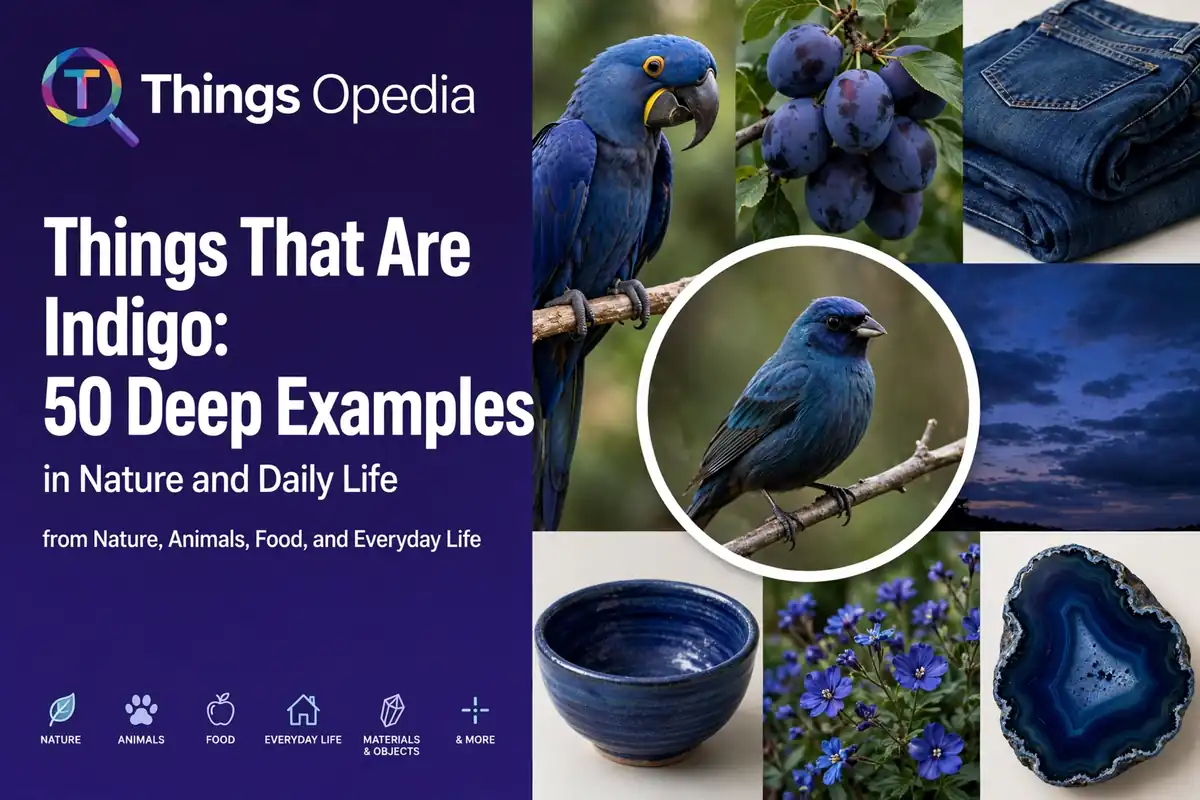
Things That Are Indigo: Deep Examples in Nature and Daily Life
Indigo is a deep blue colour with a touch of violet. You see it in the sky just after sunset, in dark berries, and in the jeans people wear every day. It looks serious and calm, and people have used it as a dye for thousands of years.
The colour comes from a plant. Leaves of the indigo plant hold a chemical that turns deep blue when dyers soak the leaves and leave the cloth in the air. Dark fruits and flowers get a similar colour from pigments that protect them from sun. In this guide, you’ll discover 50 things that are indigo, from dye plants and deep-blue birds to food, clothes, and evening skies, all explained in simple words.
Why Indigo Is So Deep
Indigo looks deep because it absorbs most light and reflects only dark blue-violet light. In berries and flowers, pigments called anthocyanins also make the dark colour and protect the plant from strong sun and cold.
In the sky, indigo appears at dusk because the sun is low and most light is gone. Only the short blue waves stay, and they also mix with the dark of night. The colour hides in the leaves as a pale substance. Soaking and beating the leaves in water frees it, and air turns it into the deep blue dye.
Indigo in Nature
Things that are indigo are rare in nature, so each deep blue example stands out.
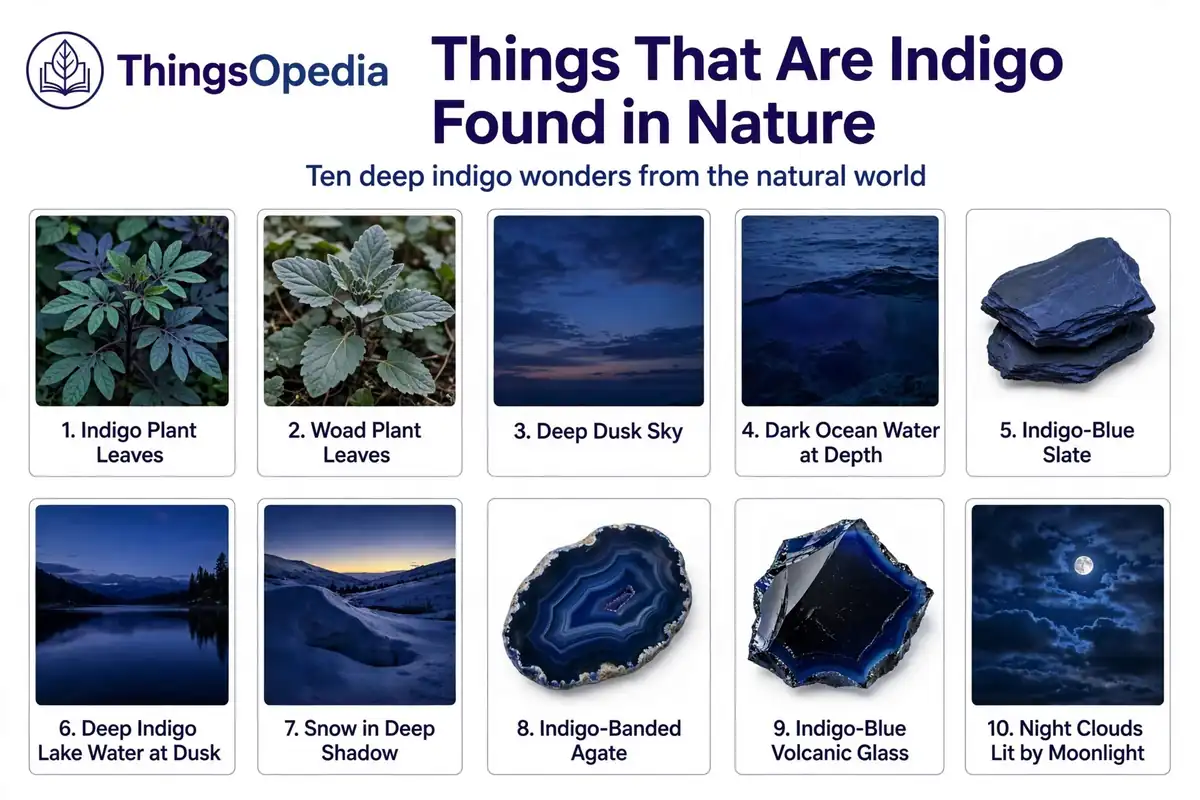
1. Indigo Plant Leaves
Indigo plants grow in warm fields, and their leaves hold the colour that makes indigo dye. Farmers also soak the leaves in water, and air turns the pale liquid into a deep blue dye.
2. Woad Plant Leaves
Woad grows in cool fields in Europe, and its leaves make a deep blue dye like indigo. People also used woad for cloth long before modern dyes reached Europe.
3. Deep Dusk Sky
Just after sunset on a clear evening, the sky turns deep indigo-blue. The sun is gone, and only short blue waves stay to mix with the dark.
4. Dark Ocean Water at Depth
Far from shore, deep water takes in most light and leaves only dark blue-indigo tones. On a cloudy evening, the surface itself can also look indigo.
5. Indigo-Blue Slate
Some slate from mountain quarries shows a dark blue-violet tone. Builders also use the stone for roofs and floors because it is hard and lasts for years.
6. Deep Indigo Lake Water at Dusk
At dusk, a still lake can look deep indigo as the light fades. The water also reflects the dark sky, and the shore turns black against it.
7. Snow in Deep Shadow
In mountain valleys in winter, snow in deep shadow can look pale indigo-blue. The shadow is also lit only by the sky, so the white snow takes on the sky’s blue tint.
8. Indigo-Banded Agate
Some banded agate shows dark indigo-blue stripes. The stone forms in layers inside volcanic rock, and cutters also polish it to show the bands.
9. Indigo-Blue Volcanic Glass
Some volcanic glass looks almost black, but thin edges can shine indigo-blue in strong light. The glass also forms when lava cools so fast that no crystals can grow.
10. Night Clouds Lit by Moonlight
On a moonlit night, thick clouds can look deep indigo against the sky. Moonlight also scatters through the cloud, and the dark parts stay indigo-blue.
Indigo Animals
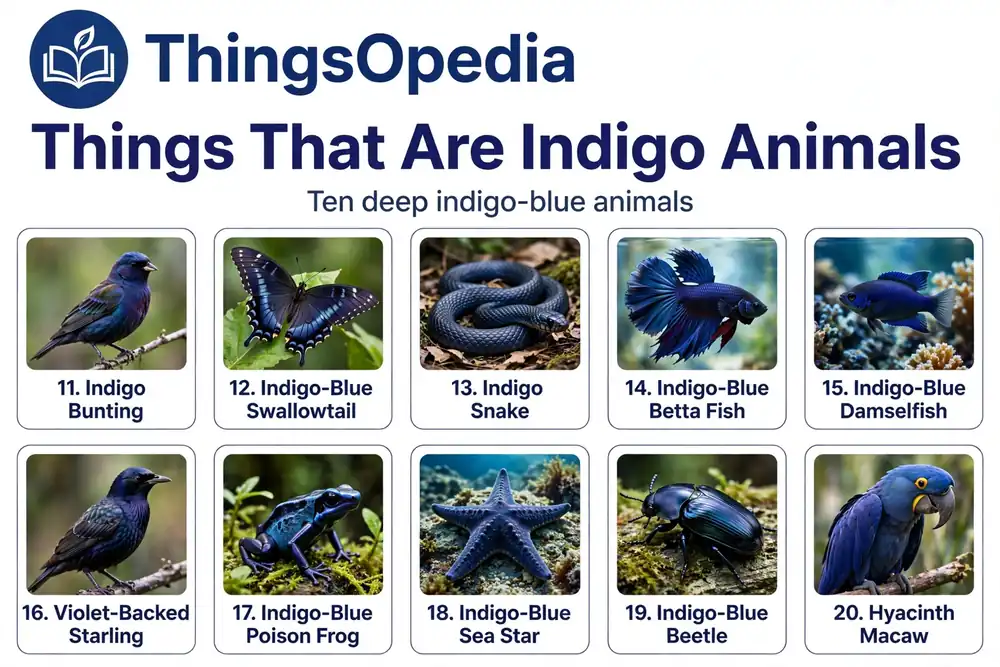
Deep indigo-blue animals are uncommon, and most use the colour to hide or to warn.
11. Indigo Bunting
The indigo bunting lives in North American woodlands, and males show deep indigo-blue feathers in sunlight. Females are brown and also hide in bushes while they sit on eggs.
12. Indigo-Blue Swallowtail
This butterfly lives in Asian forests and shows dark indigo-blue patches on its wings. The dark colour also helps it blend into shade as it flies between trees.
13. Indigo Snake
The indigo snake lives in southern wetlands in the United States, and its skin looks glossy dark blue-black, sometimes indigo in sunlight. It also eats other snakes and small animals, and it is not venomous.
14. Indigo-Blue Betta Fish
Some betta fish kept in home aquariums show deep indigo-blue fins. Males also flare their fins to impress other fish and to guard their space.
15. Indigo-Blue Damselfish
Some damselfish live on coral reefs and show deep indigo-blue bodies. They also guard small patches of reef and chase away fish that swim too close.
16. Violet-Backed Starling
This bird lives in African woodlands, and males have a glossy indigo-violet back. The shine also comes from the structure of the feathers, not from pigment alone.
17. Indigo-Blue Poison Frog
Some poison frogs in South American rainforests show deep indigo-blue skin. The colour also warns predators that the skin holds poison.
18. Indigo-Blue Sea Star
In shallow tropical seas, some sea stars show deep indigo-blue arms. They also move slowly over sand and rock and eat shellfish.
19. Indigo-Blue Beetle
In warm forests, some beetles have a hard shell that shines indigo-blue in light. The shine also comes from thin layers in the shell that bend light.
20. Hyacinth Macaw
The hyacinth macaw lives in South American wetlands, and its feathers are a deep indigo-blue. It also uses its strong beak to crack palm nuts that other birds cannot open.
Indigo Flowers
Deep indigo flowers are prized in gardens because the colour is so rare.
- 21. Indigo Iris — grows in garden beds; some varieties also open deep indigo-blue flowers in spring.
- 22. Indigo Larkspur — also grows in cool gardens; tall spikes also carry deep indigo-blue flowers.
- 23. Indigo Salvia — grows in sunny borders; spikes of deep indigo-blue flowers also attract bees.
- 24. Indigo Clematis — climbs garden walls; some varieties also open large indigo-blue flowers.
- 25. Indigo African Violet — grows indoors in pots; some varieties also open deep indigo-blue flowers.
Indigo Fruits and Vegetables
Dark fruits and vegetables often show indigo when they are ripe.
- 26. Indigo-Blue Plums — grow in orchards; dark skins can also look indigo-blue in sunlight.
- 27. Blackcurrants — also grow in cool gardens; small dark berries also look indigo-blue when ripe.
- 28. Indigo-Blue Grapes — grow in vineyards; some table grapes also have deep indigo-blue skins.
- 29. Indigo-Blue Figs — also grow in warm orchards; dark figs can also look indigo-blue when ripe.
- 30. Indigo Eggplant Skin — grows in warm gardens; glossy skin is so dark it can also look indigo-blue in shade.
Indigo Foods
Indigo foods are few, but each one shows the colour clearly.
- 31. Indigo-Blue Berry Jam — made at home; dark berries also cook into a deep indigo-blue spread.
- 32. Indigo Rice — served in Southeast Asian food; rice is also coloured indigo-blue with butterfly pea flowers.
- 33. Indigo-Blue Jelly Sweets — sold in sweet shops; soft sweets are also coloured deep indigo-blue.
- 34. Butterfly Pea Flower Tea — served hot or cold; the flowers also turn water deep indigo-blue, and lemon can change the colour.
Indigo Household Items
Deep indigo fabric and dishes give a room a calm, formal feel.
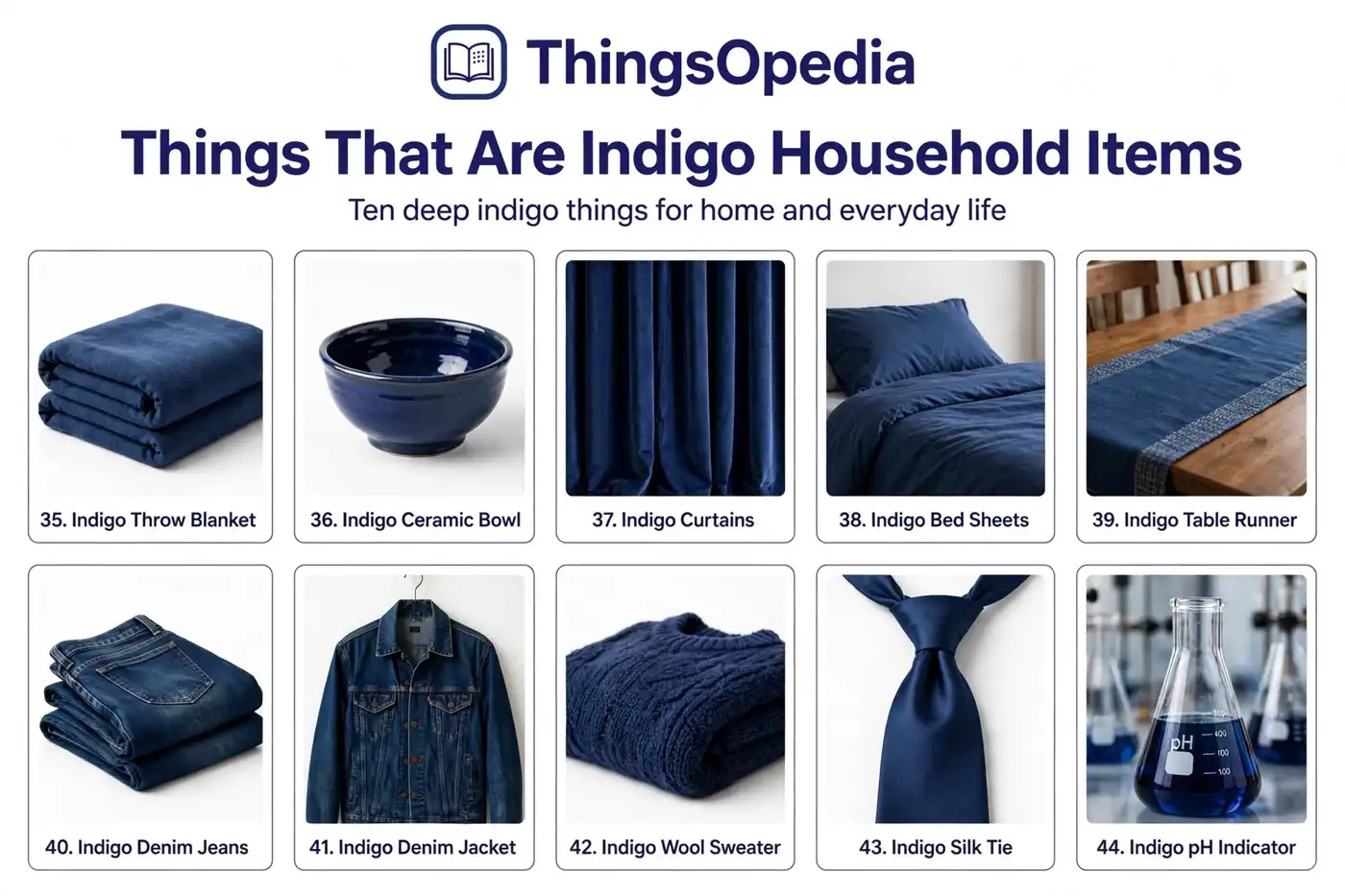
- 35. Indigo Throw Blanket — rests on beds and sofas; woven fabric in deep indigo-blue also adds warmth to a room.
- 36. Indigo Ceramic Bowl — used for rice and soup; glazed bowls in deep indigo-blue are also common in kitchens.
- 37. Indigo Curtains — hang in bedrooms; heavy fabric in indigo-blue also blocks light and keeps a room cool.
- 38. Indigo Bed Sheets — used on beds; cotton sheets in deep indigo-blue also feel cool in summer.
- 39. Indigo Table Runner — lies on dining tables; cloth in indigo-blue also suits evening meals.
Indigo Clothing and Fashion
Indigo is the classic colour of denim and formal blue clothes.
- 40. Indigo Denim Jeans — worn every day; denim is dyed indigo-blue, and the colour also fades with wear.
- 41. Indigo Denim Jacket — also worn in cool weather; indigo denim also pairs with light shirts.
- 42. Indigo Wool Sweater — worn in winter; thick wool in deep indigo-blue also keeps the body warm.
- 43. Indigo Silk Tie — also worn with suits; deep indigo-blue silk also suits formal events.
Indigo in Technology and Science
Indigo appears in labs, books, and artists’ paints.
- 44. Indigo pH Indicator — used in school labs; some liquids also turn indigo-blue when they change.
- 45. Indigo-Blue Book Cover — also used for school books; deep indigo-blue covers are also easy to find on a shelf.
- 46. Indigo-Blue Paint Tube — used by artists; paint in indigo-blue also mixes with white to make pale shades.
Indigo in Transportation
Deep indigo vehicles and gear are easy to spot in a crowd.
- 47. Indigo City Taxi — runs on city streets in some places; some taxis are also painted deep indigo-blue.
- 48. Indigo-Blue Bicycle Helmet — worn by riders; hard shells in indigo-blue are also easy to see.
Indigo in Space and Phenomena
Beyond Earth, indigo appears in light from deep space and deep seas.
- 49. Indigo Nebula in Telescope Photos — seen in deep-space photos; some gas clouds are also coloured indigo-blue by the filters astronomers use.
- 50. Indigo-Blue Deep-Sea Glow — seen in deep ocean photos; some sea animals also glow indigo-blue in the dark.
Indigo in History and Trade
Indigo dye travelled from India along trade routes to Africa, the Middle East, and Europe. In West Africa, dyers also made deep blue cloth that was prized in markets, and the dye became one of the most traded colours in the world.
In the Americas, indigo was grown on plantations, and the dye later coloured denim. Blue jeans spread around the world in the 1800s, and indigo is still the colour of most jeans today.
What Indigo Means to People
People link things that are indigo with depth, calm, and wisdom. It feels serious without feeling cold, so schools, uniforms, and bedrooms often use it.
Indigo is commonly linked with:
- Calm
- Deep
- Trustworthy
- Wise
- Formal
Fun Facts About Indigo
- The word indigo comes from a Greek word meaning “from India”.
- Isaac Newton named indigo as one of the seven colours of the rainbow.
- Indigo dye was once traded at high prices, and traders called it “blue gold”.
- Indigo does not dissolve in plain water, so dyers must dip cloth many times to build a deep colour.
- Cloth coloured with indigo was found in Egypt thousands of years ago.
- The indigo plant grows in warm parts of Asia, Africa, and the Americas.
- In warm places, farmers can cut indigo plants more than once in a year.
- Many school uniforms use indigo-blue cloth because it hides marks and looks neat.
You Might Also Like
- 50+ Things That Are Purple: Beautiful Examples in Nature & Life
- Things That Are Dark Purple: 85 Stunning Examples from Nature, Food & Gemstones
Frequently Asked Questions
What plant gives indigo dye?
The indigo plant, and its close kin woad, hold the colour in their leaves. Soaking the leaves frees the dye, and air turns it deep blue.
Why do jeans fade?
Indigo sits on the surface of cotton threads instead of soaking right through. Washing slowly rubs the colour off the surface.
Is indigo the same as purple?
No. Indigo is a deep blue with a violet touch, while purple leans more to red. The two look alike in dim light, but side by side the difference is clear.
What colour do butterfly pea flowers make?
They turn water and rice a deep indigo-blue. A squeeze of lemon can change the drink toward violet.
Why does the evening sky look indigo?
After sunset, most sunlight is gone and only short blue waves are left. The dark of night mixes with those waves, so the sky looks deep indigo.
Final Thoughts
From dye plants and deep-blue birds to dark berries, denim, and evening skies, indigo shows up in nature, food, and daily life. It is a colour with a long history and a calm, deep look.
When you notice things that are indigo in daily life, think about where the colour comes from. In plants it is a pigment, in the sky it is fading light, and in cloth it is a dye that has crossed the world. Look for indigo at dusk, in a market, or in a wardrobe. Once you know how dyers make the colour, you will see it in more places than you expected.