Things That Are Black and White: 45 Fascinating Examples
Black and white is one of the most recognizable color combinations in the world. Despite lacking bright hues, this timeless contrast has influenced art, science, architecture, fashion, photography, wildlife, and technology for centuries. The balance between darkness and light creates visual clarity, emotional depth, and universal appeal.
From giant pandas roaming bamboo forests to the zebra’s iconic stripes, from piano keys to newspaper print, things that are black and white are deeply embedded in everyday life. This striking combination is more than an aesthetic choice—it often serves practical, biological, or symbolic purposes.
In this article, we’ll explore fascinating real-world examples across multiple categories, uncover why black-and-white designs are so effective, and examine how this classic contrast continues to shape modern culture.
Why Black and White Is So Powerful
The human eye naturally detects contrast. Black and white represent the highest possible visual contrast, making objects easier to distinguish, especially from a distance.
Studies in visual perception have shown that high-contrast imagery improves readability, object recognition, and accessibility. This explains why road signs, printed books, QR codes, and official documents frequently rely on black-and-white designs.
Beyond functionality, the pairing symbolizes duality across cultures:
- Light and darkness
- Good and evil
- Simplicity and sophistication
- Balance and harmony
This universal symbolism has helped black and white remain relevant throughout history.
Animals That Are Naturally Black and White
Nature provides some of the world’s most beautiful black-and-white creatures.
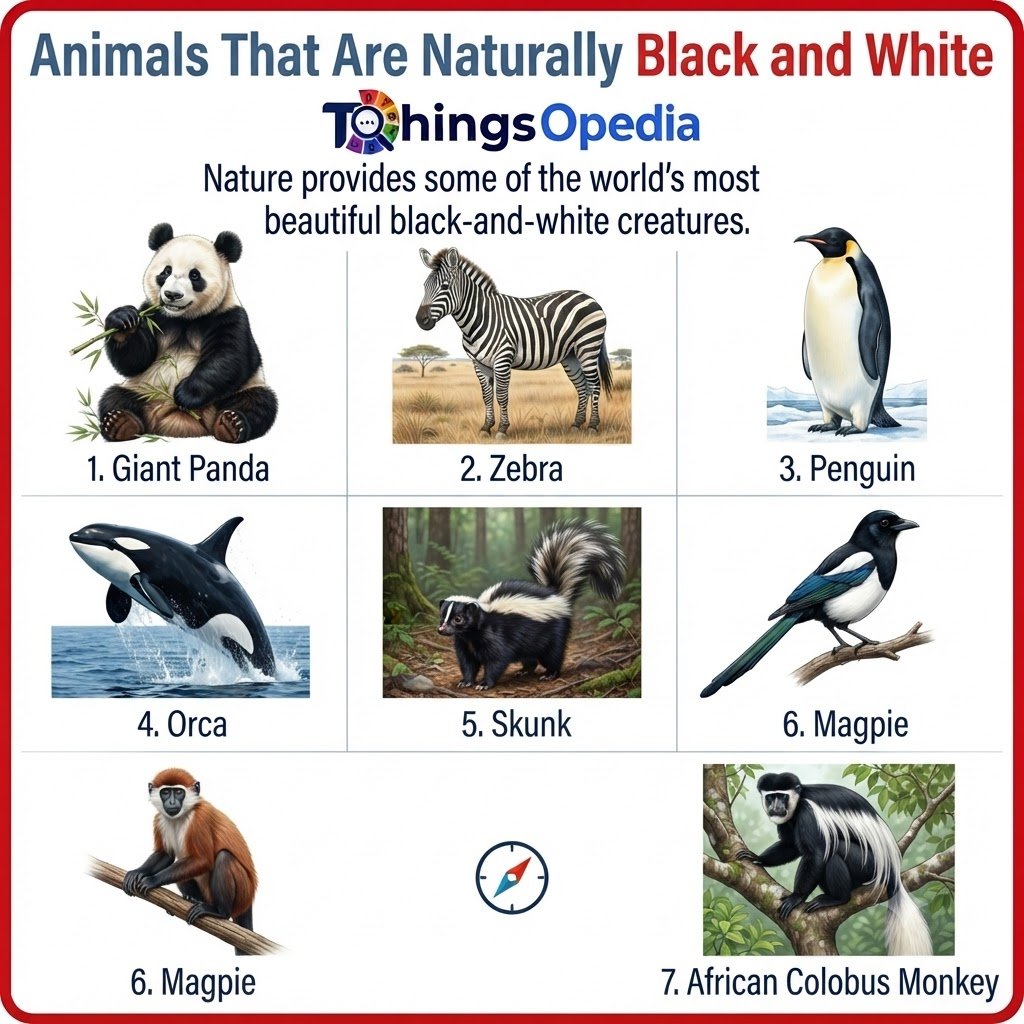
1. Giant Panda
The giant panda is among the most recognizable mammals on Earth. Native to central China, pandas have distinctive black patches around their eyes, ears, shoulders, and legs.
Researchers believe these markings help with camouflage in snowy and forested environments while also assisting communication with other pandas.
2. Zebra
Every zebra has a unique stripe pattern, much like a human fingerprint.
Scientists continue studying the evolutionary purpose of zebra stripes. Current research suggests they help deter biting insects, regulate body temperature, and confuse predators during movement.
3. Penguin
Many penguin species display black backs and white bellies, an adaptation known as countershading.
When viewed from above, their dark backs blend with the ocean depths. Viewed from below, their white undersides merge with sunlight filtering through the water, helping them avoid predators.
4. Orca (Killer Whale)
The orca’s bold black-and-white coloration is another example of countershading. As apex predators, orcas rely on stealth while hunting fish, seals, and even whales.
5. Skunk
The skunk’s contrasting stripes function as a warning signal.
Predators quickly learn that the distinctive black-and-white appearance often means a powerful defensive spray is nearby.
6. Magpie
Magpies are admired for their glossy black feathers combined with bright white wing patches. Their intelligence rivals that of some primates, and they are among the few birds capable of recognizing themselves in mirrors.
7. African Colobus Monkey
These elegant monkeys have silky black coats with long flowing white fur around their tails and shoulders, making them one of Africa’s most visually striking primates.
Black-and-White Objects Around Us
Many everyday objects intentionally use black and white because of visibility, simplicity, and timeless design.
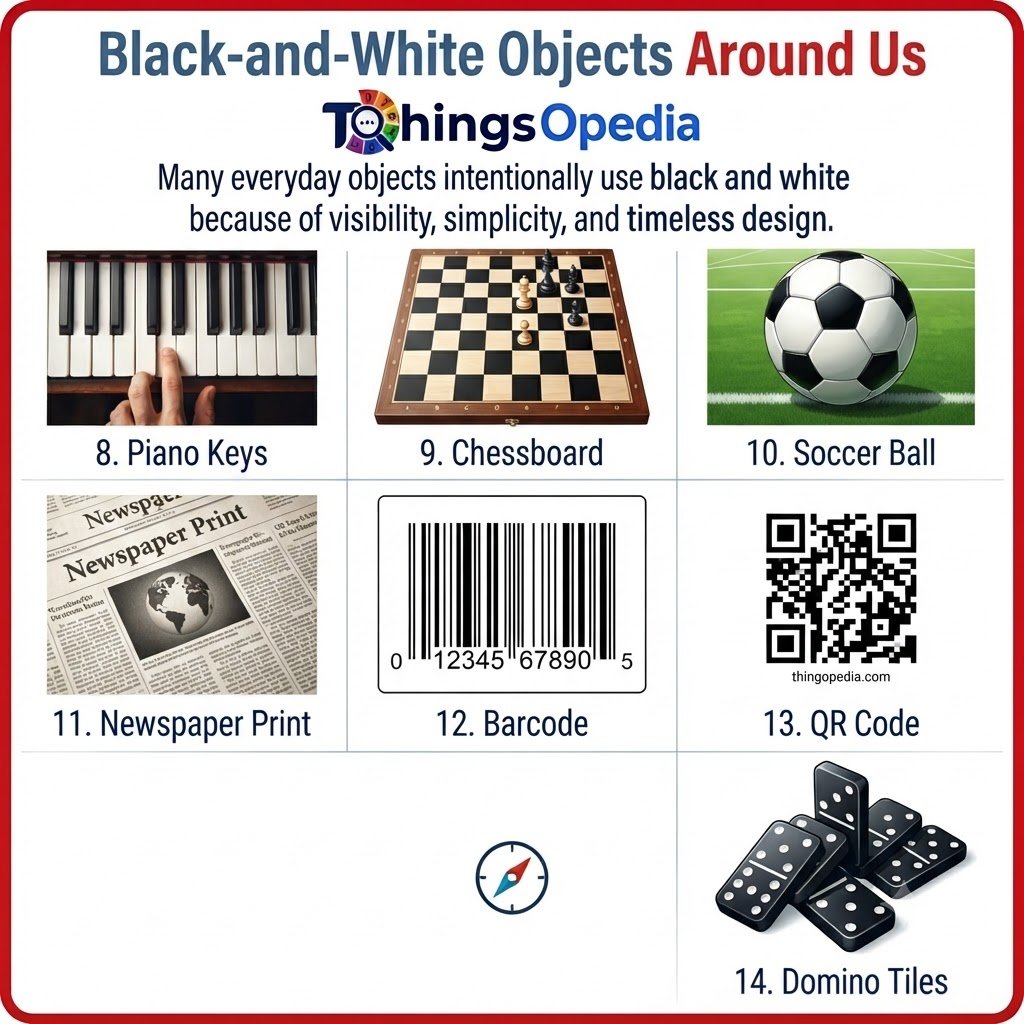
8. Piano Keys
The alternating pattern of black and white piano keys helps musicians navigate the keyboard quickly and accurately.
Although early keyboards used different materials and colors, today’s standardized layout is recognized worldwide.
9. Chessboard
The 64 alternating black-and-white squares create perfect visual organization for one of history’s oldest strategic games.
Chess remains popular globally, with millions of active players and international competitions held each year.
10. Soccer Ball
The classic soccer ball became famous after the 1970 FIFA World Cup because its black pentagons and white hexagons appeared clearly on black-and-white television broadcasts.
Modern footballs feature advanced graphics, but the original pattern remains iconic.
11. Newspaper Print
Traditional newspapers rely on black ink printed on white paper for maximum readability and cost efficiency.
Even in today’s digital era, this combination remains the global publishing standard.
12. Barcode
Retail barcodes use black lines on white backgrounds because scanners detect contrast far more effectively than color variations.
Billions of barcode scans occur worldwide every day.
13. QR Code
QR codes function using carefully arranged black squares on white backgrounds.
Their high contrast allows smartphones and industrial scanners to decode information rapidly, even under less-than-ideal lighting conditions.
14. Domino Tiles
Traditional dominoes feature white dots on black surfaces or black dots on white surfaces, ensuring players can instantly identify values.
Natural Wonders Featuring Black and White
Nature often produces dramatic monochrome landscapes.
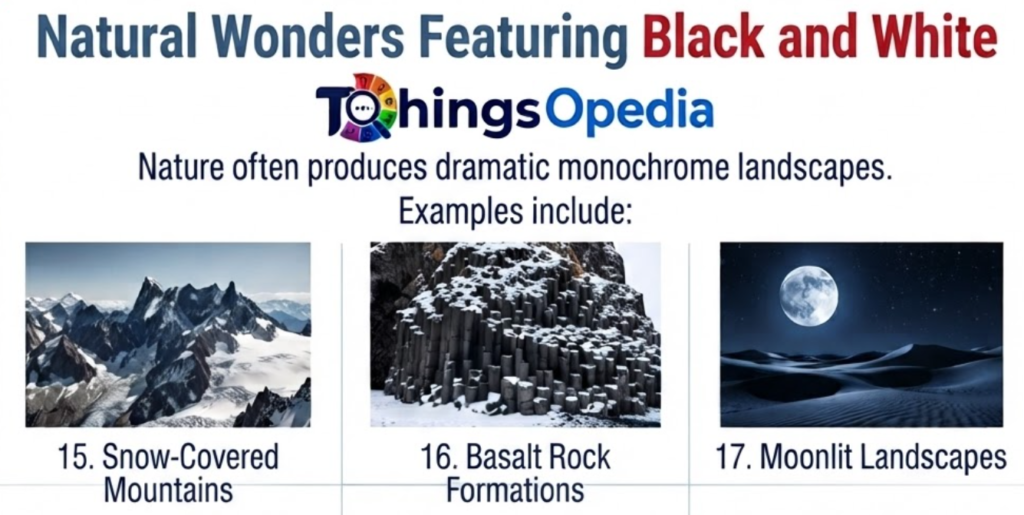
15. Snow-Covered Mountains
Dark rocky cliffs contrasting with bright snow create breathtaking scenery across mountain ranges like the Alps, Himalayas, and Rockies.
16. Basalt Rock Formations
Volcanic basalt appears almost black, while surrounding mineral deposits or snow create remarkable monochrome landscapes.
Examples include Iceland’s famous black beaches.
17. Moonlit Landscapes
Although full of subtle colors, moonlit environments often appear black and white to the human eye because our night vision relies primarily on rod cells rather than cone cells.
Fashion and Interior Design
Fashion designers consistently return to monochrome palettes because they rarely go out of style.
Popular examples include:
- Black tuxedos
- White wedding dresses
- Black-and-white striped shirts
- Monochrome sneakers
- Formal business attire
Interior designers also favor black-and-white themes for:
- Modern kitchens
- Minimalist bedrooms
- Scandinavian homes
- Luxury bathrooms
- Office spaces
These designs create elegance without relying on excessive decoration.
Technology That Uses Black and White
Many technologies intentionally prioritize contrast over color.
Printed Documents
Government forms, contracts, invoices, and textbooks commonly use black text on white paper because extensive readability research supports this format.
E-Readers
Devices like Kindle use black text on light backgrounds to reduce eye strain while maximizing battery life through electronic ink technology.
Security Documents
Passports, checks, legal certificates, and official paperwork frequently employ black-and-white printing because it improves scanning accuracy and document verification.
Black-and-White Photography
Before color photography became mainstream during the twentieth century, photographers relied entirely on black-and-white film.
Today, monochrome photography remains highly respected because it emphasizes:
- Composition
- Texture
- Emotion
- Lighting
- Storytelling
Many award-winning photojournalists still choose black and white to remove distractions and focus viewers on the subject.
Architecture Featuring Monochrome Design
Some of the world’s most admired buildings incorporate black-and-white aesthetics.
Examples include:
- Modern minimalist homes
- Marble-floored museums
- Historic cathedrals
- Luxury hotels
- Contemporary office buildings
Architects often use monochrome palettes to highlight shapes, materials, and structural details rather than decorative colors.
45 Examples of Black-and-White Things
Here is a quick reference list:
- Giant panda
- Zebra
- Penguin
- Orca
- Skunk
- Magpie
- Colobus monkey
- Piano keys
- Chessboard
- Soccer ball
- Newspaper
- Barcode
- QR code
- Dominoes
- Dice
- Keyboard keys
- Printed books
- Tuxedo
- Wedding dress
- Oreo cookie
- Cow (Holstein breed)
- Dalmatian dog
- Puffin
- Snow owl
- Killer whale
- Yin and Yang symbol
- Zebra crossing
- Vinyl records
- Newspaper crossword
- Marble flooring
- Checkered racing flag
- Panda logo designs
- Film negatives
- Piano sheet music
- Chess pieces
- Ink drawings
- Moonlit landscapes
- Snow-covered forests
- Basalt cliffs
- Printed contracts
- E-reader screens
- Minimalist interiors
- Formal business suits
- Sketch illustrations
- Vintage photographs
Interesting Facts
- Zebra stripes are unique to every individual.
- Giant pandas spend up to 14 hours each day eating bamboo.
- QR codes can store thousands of characters of information.
- Penguins use countershading to reduce visibility underwater.
- Black-and-white photography continues winning major international competitions.
- High-contrast text improves reading speed for many users.
Why Black and White Never Goes Out of Style
Unlike seasonal color trends, monochrome aesthetics remain timeless.
Businesses frequently choose black-and-white logos because they reproduce consistently across websites, packaging, documents, and merchandise.
Luxury brands often embrace monochrome branding to communicate sophistication and simplicity.
Minimalist design trends have further reinforced the popularity of black-and-white color schemes in both digital and physical spaces.
You Might Also Like:
- 55+ Things That Are Green: Nature’s Most Vibrant Color Explained
- Things That Are Blue: 75 Fascinating Examples in Nature, Science, and Everyday Life
Frequently Asked Questions
Why are so many animals black and white?
Many species evolved black-and-white coloration for camouflage, communication, temperature regulation, or warning predators. These patterns often provide survival advantages in specific habitats.
Why is black text on white paper easier to read?
High contrast reduces visual effort, making letters easier to distinguish. This is why books, newspapers, contracts, and educational materials predominantly use black text on white backgrounds.
Why is black-and-white photography still popular?
Without color distractions, photographers can emphasize lighting, emotion, texture, shape, and storytelling, creating powerful visual impact.
What industries commonly use black-and-white designs?
Publishing, technology, architecture, fashion, transportation, branding, education, healthcare, and government organizations all rely heavily on black-and-white visuals because they maximize readability, accessibility, and professional presentation.
Final Thoughts
From wildlife and natural landscapes to architecture, fashion, technology, and everyday household items, things that are black and white demonstrate how simplicity can create lasting impact. Their striking contrast enhances visibility, improves communication, and delivers timeless elegance across countless applications.
Whether you’re admiring a panda in the wild, scanning a QR code, reading a newspaper, or appreciating a classic black-and-white photograph, this iconic color combination continues to shape the world in meaningful ways. Its enduring appeal proves that sometimes the most powerful designs require only two colors to leave a lasting impression.